
Plain Township City Directory Holdings
For historical work in Plain Township, the practical shelf is Stark Library's genealogy collection. Its research material confirms the Canton City Directory and the Canton Haines Criss+Cross Directory. The conventional directory begins with a name; Haines reverses the route by beginning with an address and identifying a listed adult or business. Neither holding has a verified complete run, publisher list, or digitized Plain Township volume in the reviewed material. Ask genealogy or reference staff for the catalog and the specific volume needed rather than filling a gap with an assumed year.
| Collection | Years | Where Held | Access |
|---|---|---|---|
| Canton City Directory | Exact run not verified | Stark Library | Ask genealogy or reference staff for volumes and catalog help |
| Canton Haines Criss+Cross Directory | Exact run not verified | Stark Library | Reverse address research with staff guidance |
| Historical News Archive | 1810-1946 | Stark Library | Historical newspaper and directory research |
| Sanborn Ohio maps | 1882-1962 | Stark Library resources | Confirm coverage for a particular community |
| Stark County Index Files | Dates vary by index | Stark Library | Genealogy request and local-history assistance |
These city directory collections are routes, not a claim that every Plain Township household appears. The library also offers American Ancestors at the main library, in-library Ancestry Library Edition, Fold3, Heritage Hub, HeritageQuest, MyHeritage, NewspaperArchive, Stark Memory, and the local index files. Those companions help test a directory clue when a name is missing, spelled differently, or attached to a changing address.
Canton Directory Volumes for Plain Township
The Canton title on a printed volume does not decide a present-day jurisdiction. Plain Township is unincorporated, and its parcel records can carry Canton or North Canton postal renderings. Use a city directory as evidence of a printed name-address relationship for its edition, then test the location through the parcel's legal description and tax district. This matters most when a household lived near a postal or municipal edge. A Canton rendering is useful as a search term, but it is not proof that the address lay within Canton city limits.
The historical shelf works best with deliberate vocabulary. Try Plain Township and Canton, then rotate Middlebranch, New Berlin, and North Canton as the period calls for it. Middlebranch was a settlement by 1815, while New Berlin later became North Canton. Their names belong to different parts of the local historical record. A dated directory, tax district, or map can join the result to the right place more reliably than a postal city alone.
Plain Township Haines Address Trails
Use the Haines Criss+Cross Directory when the address comes first. It is the reverse companion to the conventional city directory volume: the address can lead to a listed adult or business, then the ordinary directory can provide the corresponding name entry. That sequence is especially helpful when a family remembers a house but not a first name. It still does not establish current occupancy, ownership, or a complete set of residents. It provides a dated printed lead that needs another record for confirmation.
For a current parcel connection, open the Stark County Public Access Site and search the address without the suffix first. Preserve the parcel number, legal description, and tax district when a plausible result appears. County property profiles separate the situs address, owner field, and tax mailing address. Those fields can differ, so they should not be collapsed into a claim about who lived at an address in a directory year.
Reading a Plain Township City Directory Entry
A printed directory entry is an adult-centered listing, not a household census. Stark Library explains that adult working men commonly appear; wives may follow a husband, often by a first name or initial. Children tend to appear at about sixteen or when working. Unmarried working women and widows may appear separately, and a widow notation can be a valuable family-history clue. Read every printed element in context and record it exactly, including initials and abbreviations.
| Name | Surname, given name, or initials; a listing may be centered on an adult or householder. |
|---|---|
| Address | A printed address that can be compared with Criss+Cross, a parcel, and a dated map. |
| Occupational clue | An entry can include an occupation, which is a clue for separating people with similar names. |
| Spouse reference | A wife may be listed after a husband by first name or initial. |
| Widow notation | A widow may appear under her own name with notation that supplies another name clue. |
- Criss+Cross directory
- A reverse directory arranged to start with an address and lead to a listed adult or business.
- Adult-centered listing
- An entry style that records selected adults, rather than every person in a home.
- Widow notation
- A printed reference that can connect a woman to a deceased spouse for further record research.
- Abbreviation
- A shortened printed term or initial that should be transcribed as shown and checked against the volume's usage.
Do not add meanings that the volume does not provide. The reviewed sources do not publish a scanned Plain Township entry or an all-years key, so a notation should be checked in the actual volume with library staff when it controls an identification.
Plain Township Directory Years and Gaps
Directory chronology has a local interruption that affects household tracing. Stark Library says the Canton city directory was often annual, became biannual in a later period, had a three-year World War II break, and is now annual. A missing household in that gap cannot be treated as a disappearance. Compare an edition before the break with one after it, then use newspapers, census material, or probate indexes to supply the missing interval.
| 1809 | Stark County organized; the Recorder's land collection begins in this year. |
|---|---|
| Directory pattern | Canton directory was often annual, then later biannual, according to Stark Library. |
| World War II | A documented three-year break interrupts the directory trail. |
| 1988 | Probate transferred older original record groups to University of Akron Archives and Stark Library. |
| Current pattern | Stark Library describes the Canton directory as annual now. |
The wartime interruption is a research feature, not an error to erase. Give each observation a year label. That habit prevents a family move, a death, and a publication gap from being mistaken for the same event.
Probate Indexes Beside Plain Township Directories
When a directory trail reaches an estate, marriage, guardianship, or will question, the historical material has more than one custody path. Stark Library lists an estate index for 1810-1890, guardianships for 1816-1900, a marriage index for 1809-1972, marriage records for 1809-1916, a will index for 1811-1942, and naturalization records for 1861-1903. Probate reports that estate files from 1810 remain on microfilm, while older originals transferred in 1988 to the University of Akron Archives and Stark Library.
The Stark County Probate Court records information directs the public to available indexes through its Records Center during weekday business hours. Staff guide visitors to indexes but do not perform genealogy research. The established FamilySearch Stark County Court Records collection covers 1809-1917 and supplies another route for court and naturalization material. Use the directory address and year as a starting detail, not as a substitute for an indexed estate or court record.
Trace Plain Township Directory Families
Family history improves when each handoff is written down. Start with a known spelling, year, and address. Copy the city directory entry exactly, then compare neighboring editions while allowing for the documented wartime gap. If the address is known first, reverse it through Haines Criss+Cross. Follow a location to the Auditor for its legal description, and then use the Recorder for ownership documents. Census material released under the 72-year rule can help test household relationships between directory observations.
- Begin with the clearest name spelling, a directory year, and any known address.
- Record the printed text exactly, including initials, street direction, and widow notation.
- Use Haines Criss+Cross when the address, rather than the name, is the starting point.
- Compare nearby editions, making a separate note for the three-year World War II break.
- Match the address to a parcel, legal description, and tax district before drawing a township conclusion.
- Test the trail with census, probate, newspaper, cemetery, and court-record resources.
One useful personal-use path combines Eby Cemetery certificates or deeds with Probate estate indexes when the evidence supports a documented family connection. The cemetery material can add a record clue, but it is not a directory of current households. A family history conclusion should remain tied to the dated entry and the official or archival record that verifies it.
Plain Township Directory Evidence and Custody
Directories can suggest where to ask next, but each follow-up record belongs to its own custodian. The Stark County Recorder keeps recorded land records and says its collection begins in 1809. The office is at 110 Central Plaza S, Suite 170, Canton, and lists 330-451-7443 with weekday hours of 8:30 a.m. to 4:30 p.m. The official CountyFusion quick-name guide describes name entries from 1982 forward, so older document work may require the Recorder counter, a mail copy request, or an archival route.
Online recorded-document copies are described as free. Staff copies are $2 per page, self-service copies are $0.10 per page, and certification is $1 per document. For mail, send the request, fee, and a stamped self-addressed envelope. The Recorder lists cash, check, money order, debit, and credit, with a 2.75% card fee. The published fee schedule is the source to check before requesting a copy.
See the Recorder's official office page before treating a directory address as a deed trail.
The Recorder is a separate source of recorded documents, not a publisher or complete repository for those volumes.
The Stark County Clerk of Courts has its own Common Pleas case responsibilities, while Probate maintains a separate historical-record path.
Use a clerk or court record only for a known case question, rather than treating it as a replacement for the library's directory shelf.
Current copy and certification information is published by the Recorder fee schedule.
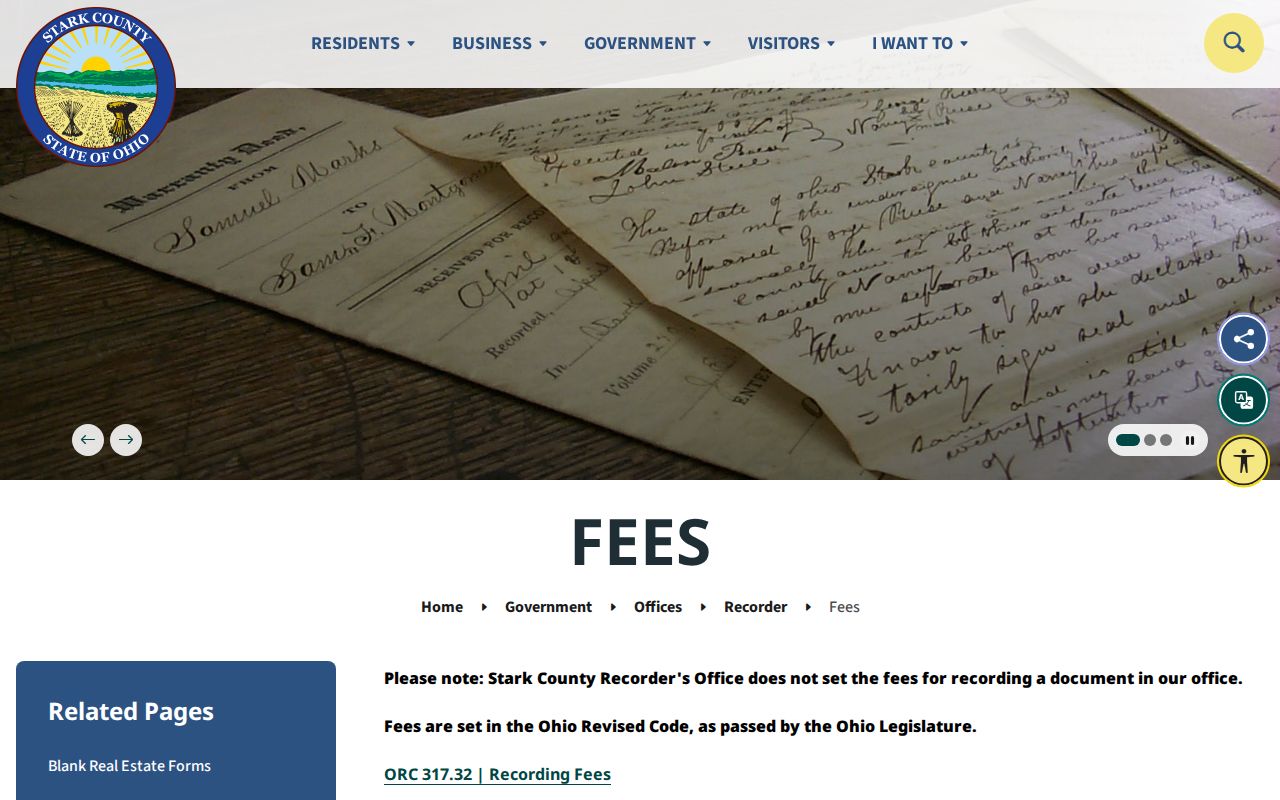
A fee schedule is a stewardship check for a document request, not evidence about a historical household.
Plain Township Family Clues Need Verification
Some directory clues point toward vital or municipal court records, but those records have their own rules. Stark County Health Department issues Ohio birth copies through its county order channel. Ohio Revised Code 3705.23 governs certified-copy access on a signed application and fee, subject to the statute's limits. Probate holds birth registrations from before 20 December 1908. These are record-access facts, not a reason to infer a relationship from printed-listing evidence alone.
Review the Stark County birth-record instructions for the available ordering routes.
Birth-record access follows the Health Department and Ohio rules, rather than the volume's listing conventions.
The Canton Municipal Court is a distinct docket route for the Plain Township service area.
A municipal docket search should answer a known court question and should not be used to expand a directory entry beyond the available record.