
Finding Plain Township Residents
A Plain Township residents directory works best when the method fits the question. For an address, begin with the Stark County Public Access Site. It returns the parcel, the owner of record, tax mailing fields, the legal description, and the tax district. All of that sits in one profile. For a person, the Ohio voter tool checks a named voter directly. Browsing a whole street that way simply is not possible. Older households call for a dated directory or a library index first. Then follow a Recorder or Probate trail.
The legal description and tax district are the stable joins. A property can carry a Canton or North Canton postal city. It may still belong to Plain Township. Owner and tax mailing fields may differ from the physical parcel address. Treat them as documented leads. Then match a record and a date before you assume every person at an address belongs together.
- Search the Stark property roll by address, owner, or parcel.
- Keep the parcel number, legal description, tax district, and the exact owner spelling.
- Use Ohio Voter Lookup only for a named person and Stark County.
- Check Recorder documents or a library directory when a date-bound question needs more evidence.
- Make a focused request to the custodian if the official online route ends.
Note: One record result shows what a single office held on a given date, not the full household at that address.
Reading the Plain Township Property Roll
The Auditor search wants owner names in LastName FirstName order, with no comma. A parcel ID may be partial but must total ten characters and carry no spaces. Searching a street address works better with the suffix left off at first. Street-only searches can surface matching addresses that way. City and ZIP are optional narrowing tools. They do not test whether a parcel lies in Plain Township. When an address format shifts, wildcards and advanced criteria help. The Stark County Public Access Site lays out owner, situs address, mailing name and address, legal description, tax district, land use, acreage, review data, values, sales options, and GIS links, sometimes alongside tax-program fields. A tax mailing address or an owner-occupancy credit is not a resident list.
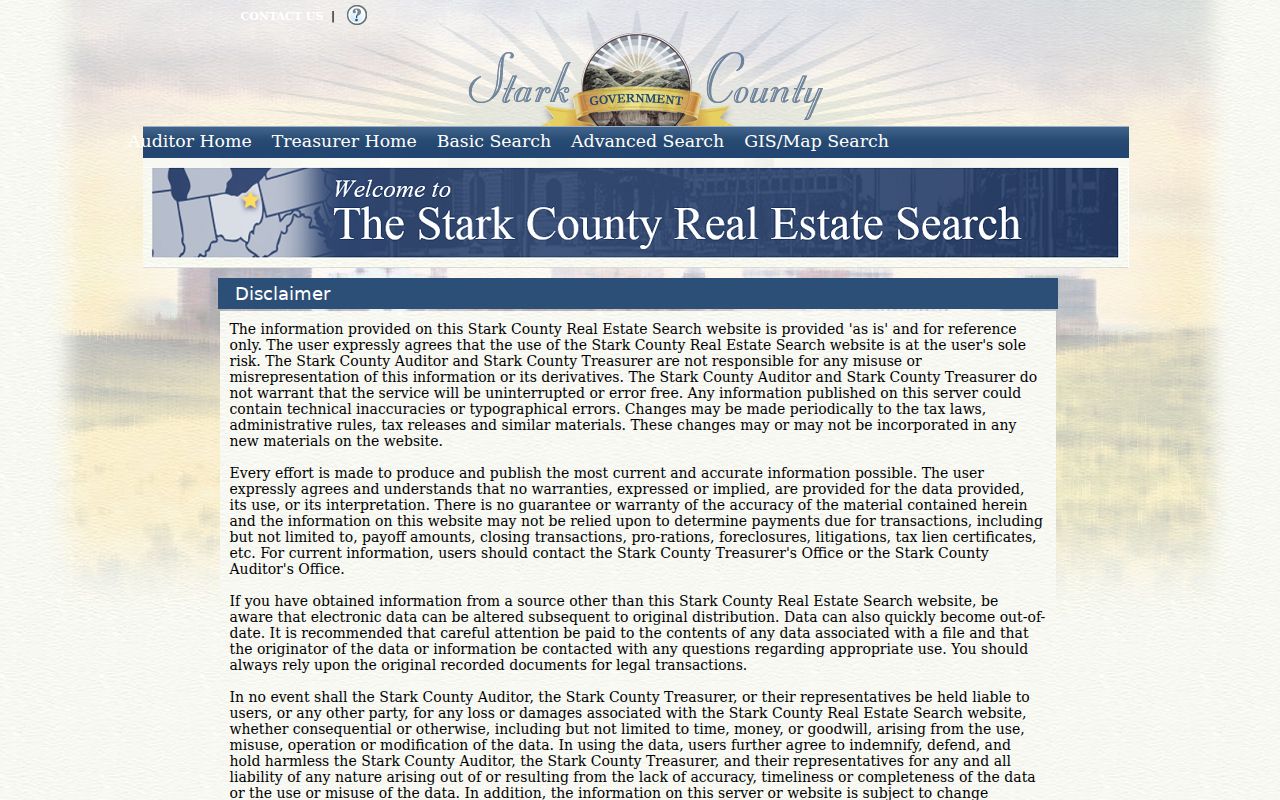
The profile earns its keep by placing the parcel and tax district right beside the postal address. Make that comparison before reading Canton or North Canton as a jurisdictional answer.
Plain Township Recorder Name Trails
Stark County's land collection starts in 1809. The Recorder quick guide says online name entries only run from 1982 forward, though. The documented quick method is simple. Enter surname then first name with no punctuation. Leave other fields alone, select Search, and open the specific record through an Instrument #. Record the party spelling, date, and legal description before stepping backward through a land trail. The CountyFusion Recorder entry point is the official online start. If it fails, use the counter, phone, or mail-copy route. If the record predates the online span, the same routes apply. Online copies are described as free. Staff copies run $2 per page, self-service copies $0.10, and certification $1 per document. Confirm the terms before sending any request, fee, or stamped return envelope.
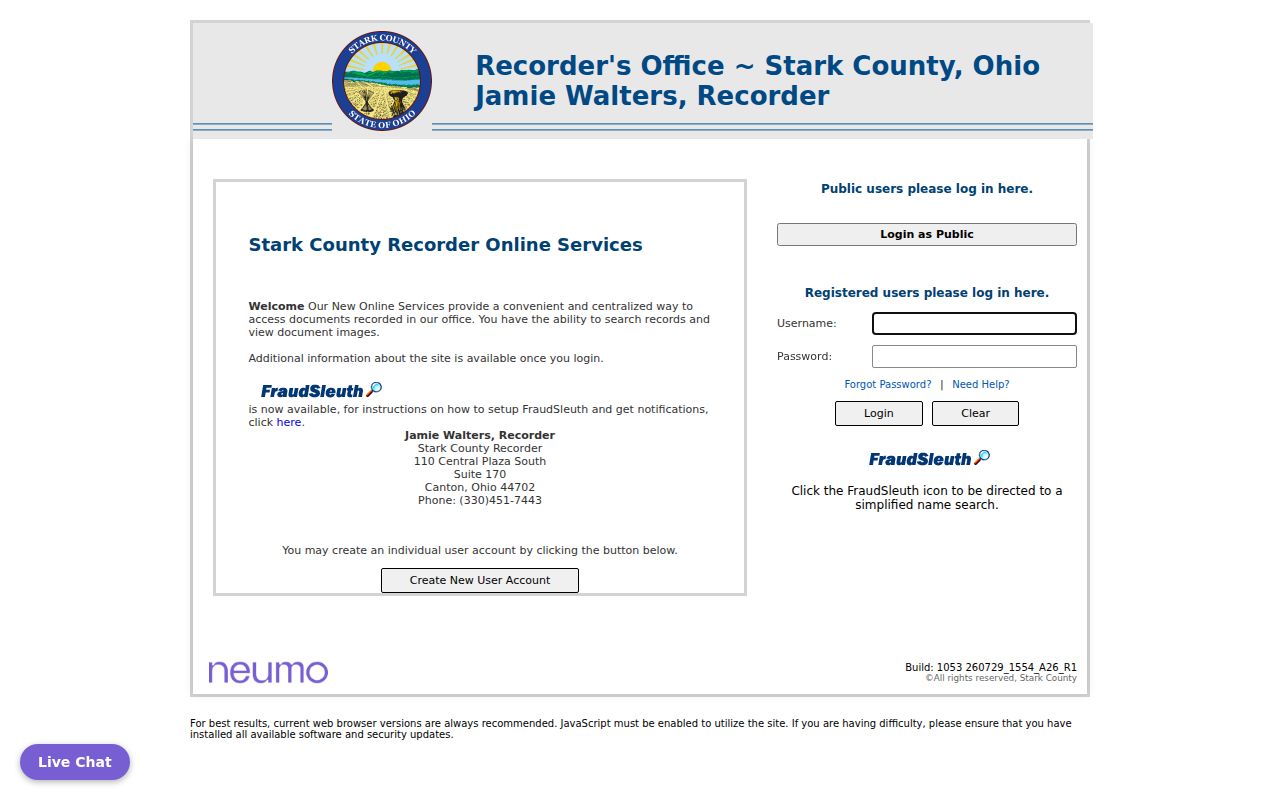
Recorder parties prove a recorded-document connection, nothing more. They do not establish present residence. Pair an instrument with the same parcel's legal description and another dated source before calling names a match.
Plain Township Records Custodians
Plain Township keeps no single city-hall residents roll. Stark County offices hold the property, land, court, probate, map, and building layers instead. State offices supply voter and other statewide tools. The right counter depends on the question. A parcel, a recorded instrument, a case, a historic estate, or a registration each leads somewhere different. The address-focused chain appears in the Plain Township street directory.
Stark County Recorder
110 Central Plaza S, Suite 170
Canton, OH 44702-1409
330-451-7443
CountyFusion document search
Stark County Auditor
110 Central Plaza S, Suite 220
Canton, OH 44702
330-451-7357
Public Access Site
Stark County Board of Elections
3525 Regent Avenue NE
Canton, OH 44705
330-451-7000
Plain Township records live with several different custodians. No single portal covers them all. The Recorder, Auditor, and Board counters handle narrow file questions in person, while Probate, the Clerk of Courts, GIS, Tax Map, and the Building Department each support a different record type. Knowing the custodian saves the trip.
Civil, criminal, domestic-relations, and juvenile cases run through the Clerk of Courts and Stark CJIS. Municipal cases sit elsewhere. Canton Municipal Court posts a Docket Search and states it serves Plain Township. For a known case, start with the official online route. Then call or visit the right court counter. That works for files and copies not online. Probate is a separate world. Estates, guardianships, wills, marriage licenses, and historic probate material all belong there. The Probate records route offers counter, index, and archive paths rather than one complete online file.
Birth records have their own split. The Stark County Health Department reaches Ohio birth records through online ordering and an in-person kiosk. Registrations before December 20, 1908 belong to Probate's historic route. Ohio Revised Code 3705.23 allows certified copies on a signed application and fee, subject to its stated limits. A historical index points to a custodian. It is not a public name list.
The Stark GIS viewer supplies parcel search, layers, select, identify, measurement, and print controls. A selected parcel can be compared with the Auditor profile. The Building charge search accepts a permit or invoice number, an owner in last-name-first order, a project street number and name, or a contractor. Use one criterion at a time. No public index covers Township zoning files. Contact Zoning with a defined address, date range, and record category, or use a narrow R.C. 149.43 request if needed. Plain Township Zoning lists 330-492-4686 and weekday hours of 8:00 a.m. to 4:00 p.m. House numbers belong elsewhere. Stark County House Numbering takes those calls at 330-451-7389.
A permit layer can date a project. It cannot identify a household. Pair a permit clue with the Recorder, a dated directory, or a parcel, because a portal is one channel among many in Plain Township research.
Plain Township Voter Checks by Name
The Ohio Voter Lookup answers one kind of question. It is a specific-person tool. You enter a first name, a last name, and Stark County, then resolve an address choice if the service asks for one. A successful result can display registration status, precinct, and polling location. That makes it useful only after a person is already identified. The service publishes no browseable Plain Township street list, so it is not a substitute for a residents directory or street directory when the goal is a block-by-block resident lookup.
For a county-file question tied to a date, the Ohio DATA Act archive works differently. It offers election selection, start and end date controls, county selection, Search, Clear, and Batch & Download. A selected date span is limited to seven days. The archive preserves at least 22 months of county voter-file snapshots. Telephone numbers and email are not public voter fields, and protected addresses can be suppressed. What you receive is a county registration file generated for one particular day. Treat it as a date-specific public-record route, not proof that every listed person currently holds the same address. The Board of Elections can explain access and inspection procedures whenever a public file is needed.
The Board lists regular weekday hours of 8:30 a.m. to 4:30 p.m. Its office sits at 3525 Regent Avenue NE, Canton, OH 44705, and 330-451-7000 is the main telephone. A request that names the person, address, requested date, and public fields works far better than an open-ended search request. State guidance permits inspection while recognizing that copying may be limited when it would interfere with election administration. Participation history, where it appears in registration records, identifies an election in which a ballot was cast, never a ballot choice. When data you want is not part of the individual lookup display, ask the Board which public file, date, or inspection route applies rather than assuming the voter form is the complete record. The county archive suits historical civic research because it delivers a preserved snapshot instead of an undated name list. Before treating two records as a match, compare the selected date with a parcel or directory date. The election route should never be used to infer a protected address, to bypass a missing result, or to reconstruct a block of individuals from the individual lookup form.
Note: A voter result confirms only the limited information the official service displays at that time, not every household member or every address tied to a similar name, mailing field, or older directory entry.
Plain Township Record Terms That Matter
Words carry narrow meanings across records systems. The property profile anchors the land, the Recorder adds the recorded document trail, and the library supplies a dated directory listing. Each term is tighter than casual conversation suggests. Matching them correctly keeps a search from chasing the wrong address.
- Parcel
- A taxed land unit identified by a parcel number and legal description.
- Index
- A finding tool that points to a record. It is not automatically the record image.
- Criss+Cross directory
- A reverse directory that starts with an address and gives dated listed names or businesses.
- Legal description
- The recorded land description that can survive a changed mailing-city label or address format.
A situs address is where a parcel sits. The tax mailing address is different. It tells the Auditor where to send tax correspondence, which may be a bank, an heir, or an out-of-state owner rather than the Plain Township property itself. A plat is a recorded map. It shows how lots or a subdivision were laid out, and it becomes essential when an older residents directory entry uses a street format that no longer matches modern numbering. Mailing cities can cross the township line too. Matching a map to a recorded instrument is far easier once these terms stay separate in your head.
An Instrument # is the Recorder's control number. Enter it and one specific document opens. Grantor and grantee name the parties transferring and receiving an interest in that recorded document, and a chain of title follows those transfers backward through the deed books. That chain documents land parties only. A census, probate file, or residents directory entry may add a dated piece of family context the deeds never capture.
A docket is the court's index of case activity. It is not proof that every detail is public. Nor does it prove a party still lives at a current address listed in a filing. An index points to a record without always showing an image. A certified copy is an authenticated copy issued by the custodian under its own process. Courts and vital-record custodians restrict sealed, expunged, juvenile, adoption, and protected material, so a request should name the case or event rather than demand a broad name search.
Current Plain Township Resident Sources
Each current source in a Plain Township residents directory answers a different question. A parcel profile names an owner of record. A voter form confirms one named registrant. A Recorder search surfaces parties to a recorded document. Courts, probate files, credential records, and business filings cover narrower questions, and no combination of them proves that a single system lists every person at one Plain Township location.
| Source | What it can show | Custodian | Access route |
|---|---|---|---|
| Property profile | Owner of record, tax mailing field, parcel and legal description | Stark County Auditor | Public search, counter, phone |
| Voter Lookup | Named registration status, precinct, polling location | Ohio Secretary of State | First name, last name, Stark County |
| Recorder index | Parties to a recorded land document | Stark County Recorder | Online guide, counter, mail request |
| Probate or court path | Public case or historic filing context | Probate, Clerk, or court | Portal, counter, index, or archive |
| Library collection | Dated directory, newspaper, and index leads | Stark Library | Genealogy and reference routes |
Anchor a person with two independent records. A parcel legal description paired with a Recorder party works. So does a known address plus a correctly dated Plain Township directory entry. A same-name result with no second anchor is never enough. It cannot alone tie a person to Plain Township.
Plain Township Records: Official or Compiled
Official records name their maker. They carry a date and a correction route. Compiled commercial people lists mix names and addresses gathered at unknown times, and the differences between the two kinds of sources show up quickly. Treat any compiled list only as an unverified prompt to check the original custodian. The gap matters most when a common name, an old tax mailing address, or a changed postal label enters a Plain Township resident lookup.
| Record route | Strength | Practical limit |
|---|---|---|
| Official Auditor, Recorder, court, voter, or library source | Named custodian and documented context | Each source is limited to its own record purpose. |
| Commercial compiled list | May suggest a spelling or older address | Dates and source quality may be unclear; verify it at the custodian. |
Start with the record number.
Never pay because an unexpected message claims a new deed, copy, or account problem. Go back to the original record number and the custodian's published route. A Recorder document question belongs with the Recorder. A parcel-field correction belongs with the Auditor. A court-copy question belongs with the court. Each office can explain what it may correct and what procedure applies. That direct route beats trusting an unsolicited message.
Keep a short audit trail whenever a fact matters: record title, custodian, record or parcel number, date searched, and the exact field or document used. If the underlying record is wrong, return to that office. A different office cannot rewrite another custodian's document. Where a public office publishes a redaction or correction process, follow it and keep the response. No statewide rule promises deletion of an accurate record a custodian must keep. The same discipline guards against a misplaced identity match. Compare the date, legal description, address form, and record purpose before connecting a name to a Plain Township result. If those anchors disagree, record the conflict. Never convert it into a biographical conclusion.
Plain Township Names at Stark Library
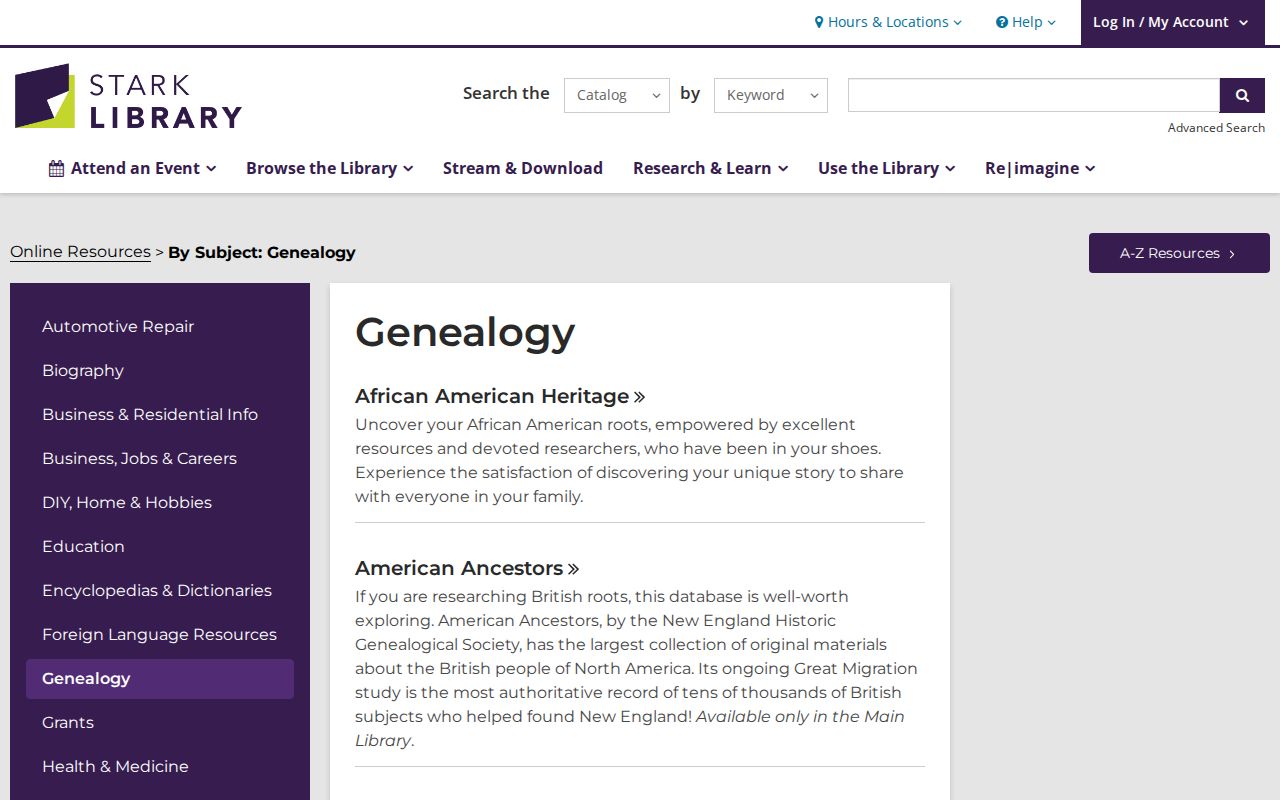
Stark Library is the local history shelf behind an older Plain Township name. Genealogy holdings include American Ancestors at the main library and in-library Ancestry Library Edition. Fold3, Heritage Hub, HeritageQuest, and MyHeritage are also part of the set. The same shelf holds NewspaperArchive, Sanborn maps for Ohio, Stark Memory, and a historical news archive covering 1810 through 1946. The library's research FAQ names the Canton City Directory. It also names the Canton Haines Criss+Cross Directory.
The Stark Library genealogy resources page is shown here. A conventional city directory walks from a name to an address. Haines Criss+Cross runs the other way. It goes from an address to the listed names or businesses for that volume's date. The library offers no published complete Plain Township directory run online. Ask genealogy or reference staff for the actual volume or catalog.
Historic city directory pages favor adults and householders. A wife often appears tucked under her husband's listing in the street directory. Children may be missing entirely. A dated residents directory entry is therefore never a full census of a Plain Township household. A printed gap usually reflects the publisher rather than a move. Stark Library notes that the Canton directory ran annually for years, then biannually. It paused three years during World War II, and prints annually again today. Compare neighboring volumes across that break. Never invent a relocation to bridge it.
The library's Index Files hold dated leads. Military discharge material, veteran grave registration, an 1865 enrollment item, newspaper deaths and marriages, and an 1875 atlas all sit there. Each is a separate finding aid rather than one merged people database. A historical news archive covers 1810 through 1946. Sanborn maps serve as an Ohio resource for 1882 to 1962. Any single community sheet still needs confirmation. These tools can rescue a name or address trail when the directory shelf runs dry. Tag each result with its date and source. For older legal and family material, the library and the University of Akron Archives hold Probate groups transferred long ago. Probate itself keeps estate microfilm dating to 1810. Staff direct visitors to the right indexes, but no service there completes a genealogy search for you.
Plain Township Results Missing by Design
Some blanks in a Plain Township resident lookup exist by law. Ohio Safe at Home issues substitute addresses. The program shields qualified participants across government records. Ohio Revised Code 149.45 controls specified sensitive information posted online and sets a defined redaction route, while voter rolls keep phone numbers and emails private. A blank result proves nothing. Blank is not proof of ineligibility, absence, or another address.
The Attorney General's Ohio Public Records Act guidance explains the general inspection and copy baseline under R.C. 149.43. A requester may stay anonymous and need not state a purpose, though a custodian can seek clarification of an unclear request. Send it to the office holding the record.
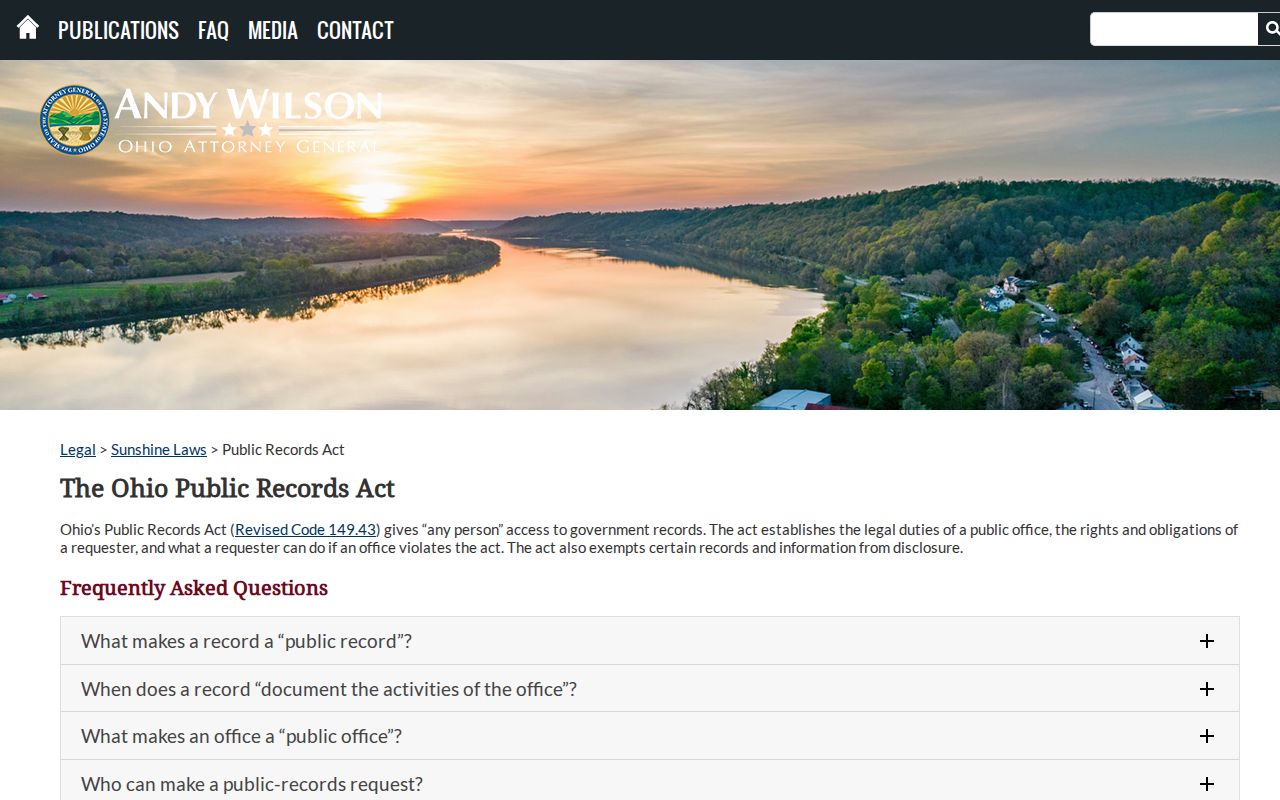
The Sunshine Law gives any person the right to inspect public records during regular office hours. It also requires copies within a reasonable period. The office must respond promptly. No universal number of days applies. An unclear request may be clarified, and a lawful exception may limit access. Name the record category. Include the address or parcel if relevant. Add the date range and the desired form of copy. Send a Township-created record request to the Township. Send a county-created request to the county custodian, since matching the request to the custodian avoids delay.
R.C. 149.45 is narrower than a general removal right. It covers specified sensitive identifiers held online. It provides a written redaction route in defined circumstances, including a five-business-day response, redaction, or explanation framework. The statute also carries defined protections for certain public-service roles, subject to its exceptions. Safe at Home is an address-confidentiality program. It is not a missing-record problem to solve by combining other searches. Ask the original custodian or the program for the lawful process. Do not try to reconstruct protected information. Motor-vehicle address data follows separate restrictions and is not an address-research fallback.
Historical Plain Township Directory Trails
The Canton directory ran mostly annual, turned biannual, paused three years for World War II, and is annual again. That break trips up many searches. Copy addresses and abbreviations exactly as printed. Compare neighboring years instead of guessing. When a Plain Township household needs more context, pair the address with the parcel legal description, Recorder instruments, census material released under the 72-year rule, and probate or newspaper leads.
Older records have three valid custody paths. In 1988, Probate transferred original material to the University of Akron Archives and Stark Library, while estate files since 1810 stay on Probate microfilm. Probate kept the rest. Stark Library holds indexes for estates, guardianships, marriages, wills, and naturalization. The Plain Township city directory collections page details the historical shelf.
Probate's archival inventory lists University of Akron groups for births from 1867 to 1908, deaths from 1867 to 1908, marriage dockets from 1809 to 1901, and naturalization from 1861 to 1903. Stark Library lists an estate index from 1810 to 1890, a marriage index from 1809 to 1972, and a will index from 1811 to 1942. Those dates describe record groups. They promise neither online access nor certified copies of every entry. Check each index on its own terms.
Plain Township's 1809 Boundary Warning
Plain Township began in 1809 among Stark County's original townships. Its territory once ran wider. Land later organized into Lake, Lawrence, and Jackson townships. So an early Plain Township reference needs a dated map and a legal description before anyone pins it to the present township. Middlebranch, New Berlin, North Canton, Canton, and Plain Township all help as historic search terms. None are interchangeable.
Recorder history reaches to 1809. The online name guide, though, only reaches back to 1982. An older address may need the Recorder counter for a document, a library directory for its dated listing, and a Probate or archive index for family context. Keep sources apart. Trust it only when all three agree.
Note: Keep the source and date beside each historic address so a changing boundary or postal rendering never becomes a false location match.
Plain Township Recorder Alerts
FraudSleuth is the Plain Township area Recorder's free alert service. It watches for documents recorded under name profiles you choose. The Recorder recommends listing nicknames, alternate spellings, and name versions stripped of periods and commas. Each alert carries a document reference, its type, and the record time. A match on a shared name, however, can be a false positive. Read the official record itself before concluding anything.
The service covers recorded documents only. It cannot verify identity, fix a parcel field, or confirm a voter record. It also reaches no other county system. An alert that surprises you deserves a closer look. Compare the reference, type, and date at the Recorder. Then ask staff about that specific instrument. If a demand for payment seems off, weigh it against the Recorder's published copy route rather than treating it as proof of trouble.